Healthy Food Toppers for Dogs: What Actually Belongs on the Bowl
Medically reviewed by Justin Shmalberg, DVM, CVA, ACVN, ACVSMR — For general education — not a substitute for veterinary care.
A good topper should earn its place with fiber, moisture, or protein your dog's gut can use — not just smell good on the way down.

On this page
Why does a topper actually change anything?
A twelve-year-old Labrador I worked with, still doing controlled leash walks twice a day for weight management, had started leaving half her kibble in the bowl by six p.m. Her owner had already tried three new bags of food that month. What actually moved the needle wasn’t a food swap — it was two tablespoons of plain canned pumpkin stirred in at dinner, added the week her stool started running loose and inconsistent after a boarding stay. Within about ten days her appetite normalized and her stool firmed back up. That’s not a case study; it’s one dog. But it’s the kind of small, mechanical fix I see more often than owners expect, and it’s a useful frame for what a topper is actually for.
What a topper is supposed to do
Before you reach for anything in the fridge, run the addition through a short checklist:
- Does it solve a real problem — poor intake, loose stool, a transition period — or is it just for fun?
- Is the amount small relative to the diet (generally under 10% of daily calories) so it doesn’t unbalance a complete-and-balanced food?
- Is it plain — no added salt, garlic, onion, or sauce?
- Does the texture or fiber content match the problem — soluble fiber for loose stool, moisture for a dog drinking too little, lean protein for a dog under-eating?
- Would you recognize every ingredient if it were on a human ingredient label?
If an item fails more than one of those, it’s decoration, not therapy. Held to that bar, most “toppers” fall into three honest categories: fiber sources, protein boosters, and moisture add-ins. Each one earns its place differently.
Fiber sources: the pumpkin question, answered plainly
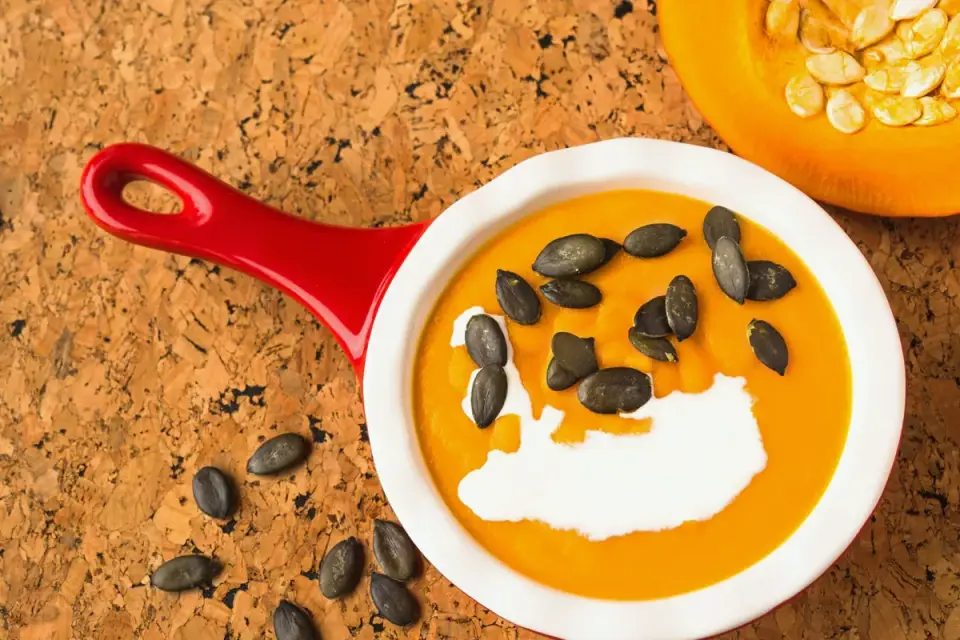
Plain canned pumpkin is the topper I recommend most often, and for a specific reason: it’s a gentle, natural source of both soluble and insoluble fiber. Soluble fiber slows transit and firms loose stool; insoluble fiber adds bulk that helps a sluggish gut move. That dual action is why it works in both directions — for the dog who’s too loose and, in smaller amounts, for the dog who’s a little backed up.
Where owners go wrong is dose creep: a spoonful becomes a quarter cup “because it’s healthy,” and now the topper is doing more digestive work than the base diet. Keep it to a tablespoon or two for a mid-size dog and treat it as a short-term tool during a transition, a stressful travel week, or a diet change — not a permanent fixture unless a vet has a reason for it to be.
Protein and moisture: what a working dog’s gut actually needs
I think about gut health the same way I think about a joint recovering from a hard training block: it’s not one ingredient doing the work, it’s the whole system — motility, microbiome balance, and what’s actually being absorbed. Plain, unseasoned proteins (poached chicken breast, scrambled egg, low-fat cottage cheese in small amounts) are useful when a dog is under-eating during a training taper or recovering from illness, because they’re calorie-dense and easy to digest without adding fiber load on top of an already irritated gut. Bone broth or a splash of warm water does the opposite job — it adds volume and moisture without meaningfully changing the calorie math, which matters for a dog who under-drinks, especially in hot weather or after long exertion.
None of this replaces working through an actual GI diagnosis with a vet. Chronic malabsorption — exocrine pancreatic insufficiency being the clearest example — needs real medical management, not a topper. EPI is treated by pancreatic enzyme replacement therapy, nutritional management (low-residue diets with moderate fat content), and supplementation of cobalamin, according to a JAVMA review. A topper can support a healthy gut through a rough week; it cannot substitute for that kind of workup.
Where fermented and probiotic add-ins fit — and where the evidence is still thin
Fermented toppers — plain kefir, a splash of unpasteurized sauerkraut brine — get pitched as a natural probiotic. The honest answer is: maybe, for some dogs, some of the time. A 2025 randomized controlled trial on canine probiotic response found that diversity metrics did not distinguish non-responders from responders, according to research published in Frontiers in Veterinary Science — meaning we still can’t reliably predict, from gut diversity alone, which dogs will actually benefit from a given probiotic input. That’s not a reason to avoid fermented foods; it’s a reason not to oversell them as a guaranteed fix. If you’re using one, treat it as an experiment with a clear endpoint — two to three weeks, tracking stool quality — rather than an indefinite add-in.
I had a client, a nine-year-old Border Collie mix coming back from a soft-tissue injury, whose owner wanted to add “everything” to speed recovery — turmeric, bone broth, kefir, salmon oil, all at once, all in the same week. I asked her to stop and add one thing at a time, two weeks apart, because if the dog’s stool changed, we’d have no idea which addition caused it. That’s not a special trick, it’s just controlling variables. Toppers are food, not a stack of interventions, and a gut that’s already working fine doesn’t need six new inputs to prove it’s working. We settled on plain pumpkin during meals and bone broth on hot days, and nothing else changed for two months.
What to actually avoid
A short list, deliberately shorter than the “yes” list: no onion or garlic powder in any broth or seasoning blend — see our full explainer on why onions are dangerous to dogs for the mechanism. No wild or unidentified mushrooms, ever; our field rule for grocery-bin versus backyard fungi covers which store-bought mushrooms are fine. No avocado flesh in any real quantity for a dog with a sensitive gut — the fat load, not the persin, is the real risk, as we cover in our avocado breakdown. And if you’re topping food during a broader diet transition, especially for an older dog, pace the change the way you’d pace a training load increase — our step-by-step senior transition guide has the timeline.
The verdict
Toppers are a small, useful lever — not a treatment plan. Pumpkin for stool consistency, plain lean protein for intake, broth for hydration: that’s the whole defensible toolkit for most healthy dogs. Protecting a balanced gut matters for whole-body health, which is exactly why it’s worth protecting with boring, well-chosen additions rather than a rotating cast of trendy ones. If a topper hasn’t changed anything measurable in two to three weeks, it isn’t the fix — the underlying issue needs a vet’s eyes, not another ingredient.
Frequently asked questions
How much topper is too much?
As a general rule, keep toppers under about 10% of a dog's total daily calories so the base complete-and-balanced diet still does most of the nutritional work.
Is plain pumpkin safe every day?
In small amounts, most healthy dogs tolerate daily pumpkin well, but treat it as a targeted tool for a specific issue rather than an automatic daily add-in, and check with your vet if stool problems persist past a couple of weeks.
Can toppers replace a probiotic supplement?
Not reliably — response to probiotics varies dog to dog, and current research hasn't found a way to predict who will respond from gut diversity alone, so a topper and a supplement are solving different problems.
Sources
- EPI treatment and nutritional management review — JAVMA
- Diversity metrics and probiotic response in dogs — Frontiers in Veterinary Science