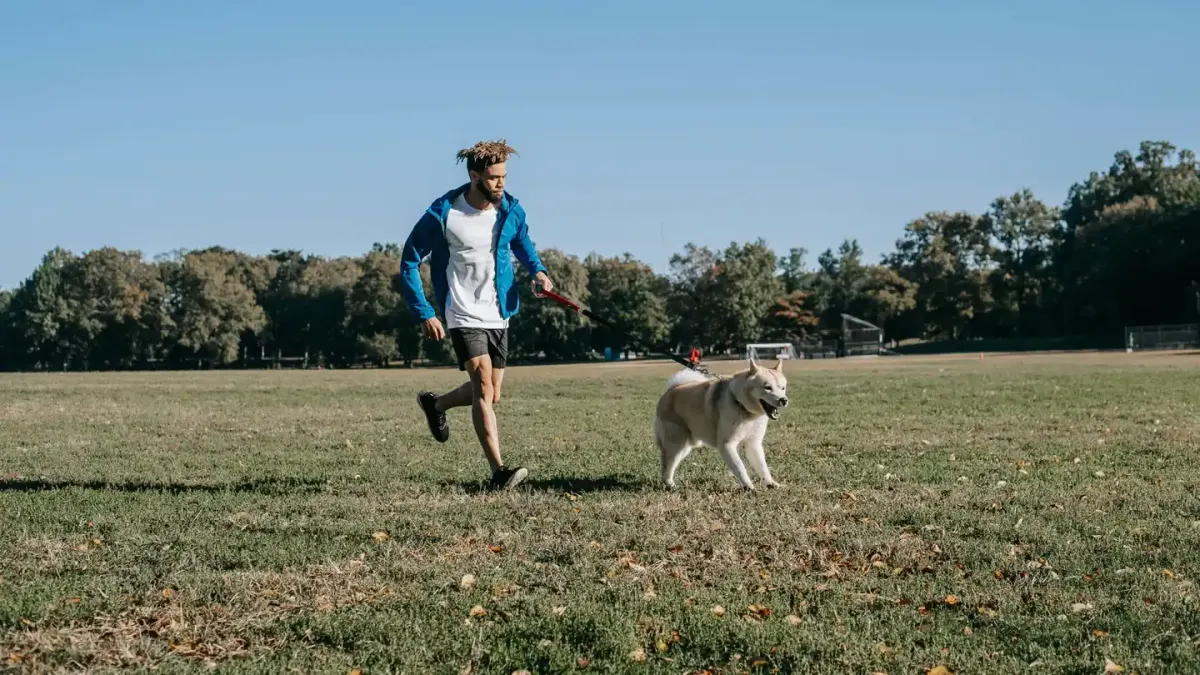
She is waiting at the door before the leash is even off the hook, a four-year-old, 48-pound cattle dog mix with her weight shifted forward, nails clicking, panting through a closed mouth. Her owner tells me the neighborhood loop takes 25 minutes but the dog spends all of it scanning — ears up, shoulders high, pulling toward every sound, then shutting down at the crosswalk. By day 10 of trying a longer, faster route to tire her out, the panting lasts an hour after they get home and the owner is wondering if exercise is helping at all.
That pattern is familiar from sports medicine. Anxiety raises muscle tension and shortens stride, which changes how load travels through elbows, shoulders, and lumbar tissue. My verdict is steady: prioritize predictable, low-impact movement that lowers arousal first, and let joint tissue adapt inside that calmer window. A supplement can realistically do only a narrow job here — it may help support normal joint nutrition and recovery, not change behavior or erase overload.
What anxiety does to load and tissue tolerance
An anxious dog does not move like a relaxed dog. The gait gets choppy, the head rides high, turns become abrupt, and the dog braces instead of pushing evenly through the hind limbs. Over a week that means more repetitive micro-load on the same structures and less true aerobic recovery.
This is where I weigh what nutrition can realistically do for diet, mobility, and recovery. Glucosamine and chondroitin are among the most studied joint support ingredients for dogs, and that history matters because we understand their limits. In laboratory work, glucosamine has been shown to prevent experimentally induced cartilage degradation in vitro in work reviewed in the Journal of Veterinary Medical Science, which is useful context but not proof of a calming effect or a performance gain. Chondroitin research includes work described as supporting healthy synovial fluid homeostasis in a Frontiers in Veterinary Science study, again a tissue-level mechanism, not a behavioral intervention.
The strongest counterargument I hear is reasonable: if the tissue is supported, why not push through with more exercise to exhaust the anxiety? I still land on the calmer plan because fatigue without recovery narrows tissue tolerance. An overtired, still-anxious dog takes corners harder and recovers slower.
Sniff-based movement fits this physiology. Allowing the nose to lead slows pace, drops the head and neck into a more neutral position, and inserts natural pauses that function like interval recovery.
Building the calm-movement week without overloading joints
Think in recovery windows, not workouts. For a very anxious dog, two or three short decompression outings often beat one long march, especially on hard pavement or in high-traffic corridors that keep arousal elevated.
He had tried the opposite with his seven-year-old, 22-pound terrier mix, adding a second evening lap around the apartment complex because the barking at hallway noises was getting worse. Three weeks in, the log told the story: the dog was covering more distance but settling later, still pacing at midnight, and starting to bunny-hop the two front steps he used to take cleanly. The failed approach was not lack of effort; it was stacking load on a nervous system that never downshifted, so the joints never got a true low-load day. When we reframed the goal from distance to decompression — same block, half the pace, long sniff stops, early turn-around before the busy intersection — the nighttime pacing eased first, and then the stair hesitation faded.
Practically, that means choosing soft, predictable footing where you can, keeping the leash long enough to permit exploration, and ending the outing while the dog can still disengage and check in with you. Owners watching for heat stress on these slower but mentally demanding walks can use the same early cues described in Signs Your Dog Is Overheating During Exercise: /articles/signs-your-dog-is-overheating-during-exercise/ — heavy panting that does not resolve with rest deserves a stop, shade, and water.
Short, deliberate pauses are productive.
For small, anxious dogs the same principle scales down to hallway fetch replaced by scent games and short courtyard loops, a point covered well in Exercise Ideas for Toy and Small Breeds: A Load-Smart Guide: /articles/exercise-ideas-for-toy-and-small-breeds/. And when weather, triggers, or footing make the street unusable, a thoughtful indoor alternative can preserve the recovery pattern without adding impact, as discussed in Dog Treadmill vs Outdoor Walking: What Actually Builds Fitness and Protects Joints: /articles/dog-treadmill-vs-outdoor-walking/.
Where joint nutrition fits, and where it stops
Food therapy and supplement science earn their place after the movement plan is sound. Green-lipped mussel is a useful example to keep bounded: it contains omega-3 fatty acids and glycosaminoglycans that have been studied for joint support, but feeding it does not train a calmer gait. Preclinical work on related marine and botanical preparations reported that BMO, GMO, and KO all alleviated paw swelling in rats and reduced serum levels of rheumatoid factor (RF), anti-cyclic citrullinated peptide (anti-CCP) antibody, and pro-inflammatory cytokines such as TNF-α and IL-17 in a Nutrients study — interesting mechanistic context from an animal model, not a reason to increase exercise volume in an anxious dog.
The edge case that changes my advice is the senior anxious dog who looks stiff after rest. A nine-year-old, 67-pound Labrador with a lifetime of noise sensitivity started lying down halfway through the quiet field route his owner had chosen specifically to avoid triggers, and by week six he needed until noon the next day to move normally after a Saturday outing. That delayed recovery shifted the question from anxiety alone to age plus load tolerance, with pain potentially amplifying the anxious behavior. That dog needed a hands-on veterinary exam, a firmer surface and distance audit, and a diet and supplement review grounded in what those ingredients may help support for whole-patient health — not a new chew and the same mileage.
Talk with your veterinarian before changing exercise volume, especially if you see lameness, prolonged panting, reluctance to start, or behavior that is worsening rather than settling.
For related context, read Exercise Ideas for Toy and Small Breeds: A Load-Smart Guide.
For related context, read Signs Your Dog Is Overheating During Exercise.
Frequently asked questions
How long should a walk be for a very anxious dog?
There is no single number. Watch recovery instead of the clock — breathing should settle within minutes of coming home, and the dog should move normally the next morning. If panting, pacing, or stiffness linger, shorten the route, choose quieter footing, and ask your veterinarian to review the plan.
Is sniffing really exercise?
For anxious dogs, yes in the sense that matters most. Nose-led walking lowers pace, encourages a neutral head and neck position, and builds in pauses that let heart rate and muscle tension reset, which keeps joint loading lower than a sustained pull-walk.
Should I use joint supplements to help my anxious dog exercise more?
Supplements may help support normal joint nutrition as part of a complete diet, but they do not reduce anxiety or raise tissue tolerance enough to justify more mileage. Set the movement plan with your veterinarian first, then discuss whether a joint product fits the diet and recovery picture.
Sources
- Chondroitin and synovial homeostasis study — Frontiers in Veterinary Science
- Glucosamine and cartilage degradation review — Journal of Veterinary Medical Science
- Marine oils and joint inflammation in rats — Nutrients