Play Bow or Aggression? Reading Dog-to-Dog Signals
What separates play from a fight is whether either dog can still choose to stop and be believed.
On this page
The first time I got called out to a “dog fight” that wasn’t one, I was maybe four years into practice. A client had separated her twelve-year-old Lab mix, Otis, and a neighbor’s young Vizsla mid-romp because Otis let out a noise she’d never heard him make. She brought him in that afternoon convinced he’d been attacked. He had one small nick on an ear, the kind you’d get from your own toenail, and a resting heart rate that told me he hadn’t been in a real altercation. What she’d heard was a play growl layered over hard breathing, the sound an older dog makes when a younger one is asking more of his joints than he’s used to giving. Otis wasn’t hurt. He was tired, and a little indignant about it. That call stuck with me because it’s so common — owners read the noise and miss the body.
The short version: the noise tells you almost nothing. The bodies tell you almost everything. Real play stays loose, self-interrupting, and reversible — a bigger dog will drop to the ground, a faster dog will let itself get caught, and either dog can peel off and rejoin without incident. A real conflict is stiff, targeted, and one-sided, and it doesn’t include voluntary handicapping. If you only remember one diagnostic, remember this: watch whether the “losing” dog is choosing to keep playing, not whether either dog is being loud about it.
Start with the shape of the body, not the volume of the mouth
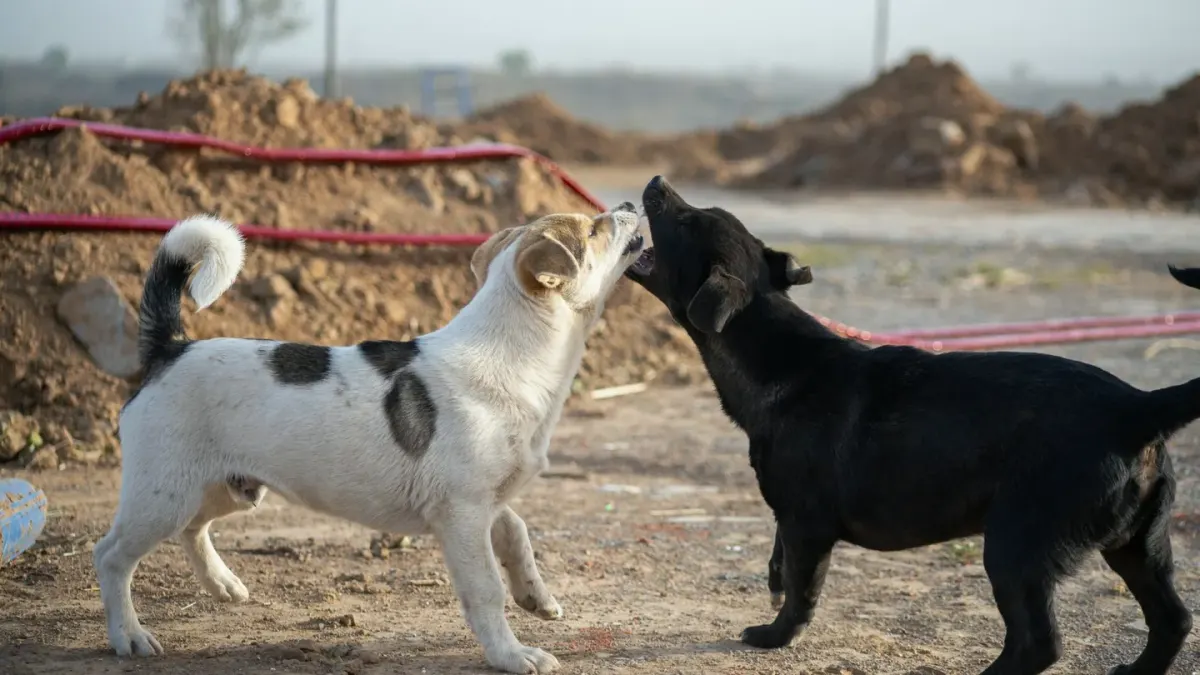
Growls, snarls, and yelps during play can sound alarming to a human ear because we don’t make those sounds when we’re having fun. Dogs do. A play growl tends to come with a relaxed jaw, a wagging or neutral tail, and a body that’s still moving toward the other dog rather than away from it. What actually separates a scuffle from a fight is posture: weight forward and low with hips up in a play bow, versus weight stacked over all four legs, stiff, with the tail high and rigid and ears pinned. A dog that’s truly escalating carries tension through the whole spine — you can often see it in the hackles running the full length of the back rather than just a patch near the shoulders.
Mouth pressure is the other tell. Play biting is inhibited — it lands soft, and it lands and releases in the same beat. A bite delivered with intent to harm doesn’t release the same way; it holds, shakes, or drives forward. If you watch closely you’ll also notice that playing dogs frequently self-handicap. A large dog will roll onto its back, let a smaller dog “win” a chase, or slow its own gait to keep the game even. That kind of voluntary disadvantage almost never shows up in a real conflict, because a dog that actually intends to dominate an interaction doesn’t hand the advantage back.
The pause test, and why it works better than watching the mouth
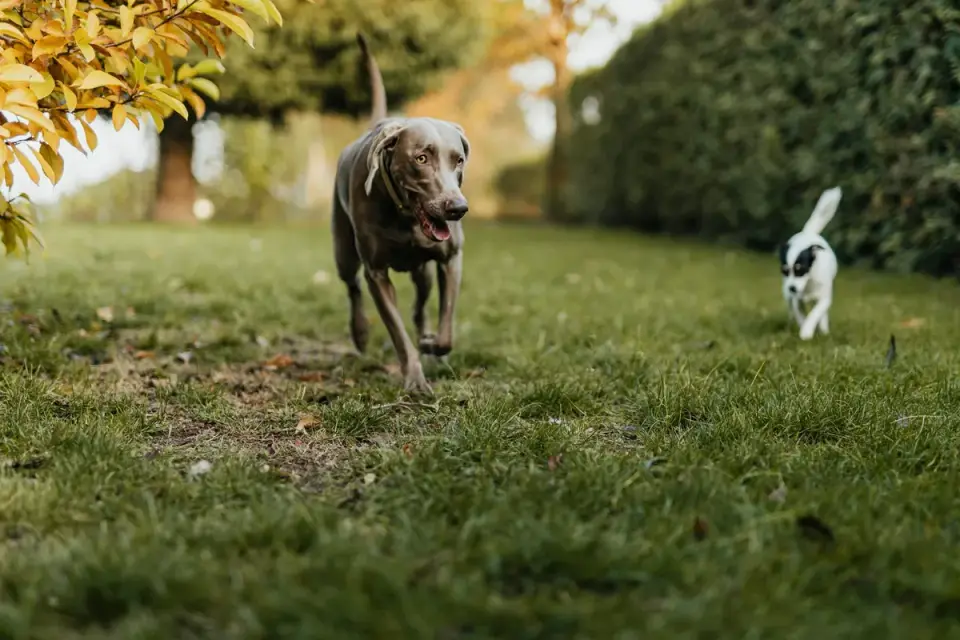
If you’re still not sure, use what trainers call the consent test: physically separate the two dogs for three or four seconds, then release them. A dog that wants to keep playing will re-engage immediately, often initiating the next round itself. A dog that was uncomfortable will create distance, avoid eye contact, or redirect toward you instead of the other dog. This works because it removes the noise entirely and asks the only question that matters — does either dog still want to be in this.
One of the recurring calls I get is from owners of a young, high-drive dog paired with an older, arthritic housemate. The mismatch matters here in a way that’s easy to miss if you’re only listening for growls. An eight-year-old dog with early hip or elbow changes may vocalize sooner in play not because the interaction has turned hostile, but because a fast pivot or a body check costs that dog more than it used to. I’ve had clients describe a fifty-pound senior retriever who used to tolerate twenty minutes of wrestling with the neighbor’s puppy and now taps out after five, grumbling on the way down. That’s not aggression escalating — that’s a joint budget running low, and it’s worth mentioning to your vet even if the interaction itself stays perfectly civil. Watching how a dog recovers afterward, whether it’s stiff getting up from a nap twenty minutes later, tells you more about whether that session was appropriate than the noise during it ever will.
When play tips over, and what genuinely worried behavior looks like
Play can escalate into something real, and it usually does it gradually rather than all at once. Watch for a shift from mutual chasing to one dog consistently pinning or cornering the other without a break in the action. Watch for a tail that goes from loose and wagging to high, stiff, and vibrating rather than swinging. Watch for one dog trying repeatedly to leave and being followed or blocked. Any of those, on their own, is worth interrupting the interaction and giving both dogs a minute to settle before deciding whether to continue.
Some dogs come out of an intense session, whether it was play that ran hot or a genuine scuffle, wound up rather than relaxed. In my practice this shows up as pacing, panting past the point of exertion, or an inability to settle for the rest of the afternoon. For dogs prone to that kind of post-arousal stress, some owners lean on ingredients with a long history in calming support rather than anything sedating. Chamomile and valerian root have been used in traditional herbal care to support relaxation, and L-theanine, an amino acid found in tea, has been studied for its calming properties, according to a Molecular Psychiatry: vet-reviewed calming-ingredient claim list that cites research on both compounds. None of that replaces separating two dogs who genuinely don’t like each other, or asking a trainer to observe a specific pair before you let them off leash together again.
Reading the dogs you already know
I think about a Border Collie–Australian Shepherd pairing I saw a few summers back, both around two years old, matched almost exactly in speed and drive. Their owners worried because the “fights” got loud enough that neighbors commented. What I watched on video was textbook play: constant role switching, mouths open and loose, both dogs voluntarily returning to a downed position to let the other one catch up. The volume was real. The risk wasn’t. Dogs that are well matched in size, age, and play style tend to sound more dramatic precisely because neither one is holding back — a mismatch, ironically, often looks and sounds calmer because one dog is working harder to stay safe. If you’re building a household with two dogs of very different builds or energy levels, it’s worth reading up on what actually predicts a good match beyond breed reputation; our guide on Best Dog Breeds for Apartment Living covers some of the same temperament variables that make two dogs compatible playmates. And if the pairing in question is specifically a herding-breed household, our Border Collie vs Australian Shepherd comparison digs into how training load and play style differ between the two.
If a dog in your home growls the moment you reach for it mid-scuffle to intervene, that’s a separate and important signal worth understanding on its own — see our piece on what the growl is telling you for how to read that specific context without punishing the warning.
What to actually do in the moment
The short version, the one I give owners standing in my exam room with a video on their phone: watch the pauses, not the pitch. If both dogs are choosing to come back, self-handicapping, and taking turns losing, let it run. If one dog is trying to leave and can’t, or the pinning has stopped rotating, step in and separate calmly — no yelling, no grabbing collars from directly above, just a body block and a leash if one’s available. Then run the pause test before you decide whether round two is a good idea. Most of the time, in my experience, the dogs answer that question faster than the owners do.
Frequently asked questions
Is growling during play always fine?
Not always, but it's common and usually not a red flag on its own. Growling paired with a loose body, open mouth, and voluntary role reversal is typically play. Growling paired with stiff posture, fixed eye contact, and no self-handicapping deserves a closer look.
What should I do if I can't tell whether two dogs are playing or fighting?
Use the pause test: separate them for a few seconds and release. A dog that wants to keep playing will re-engage on its own; a dog that was stressed will create distance or come to you instead.
Sources
- L-Theanine and Anxiety Outcomes: A Review — Molecular Psychiatry