On this page
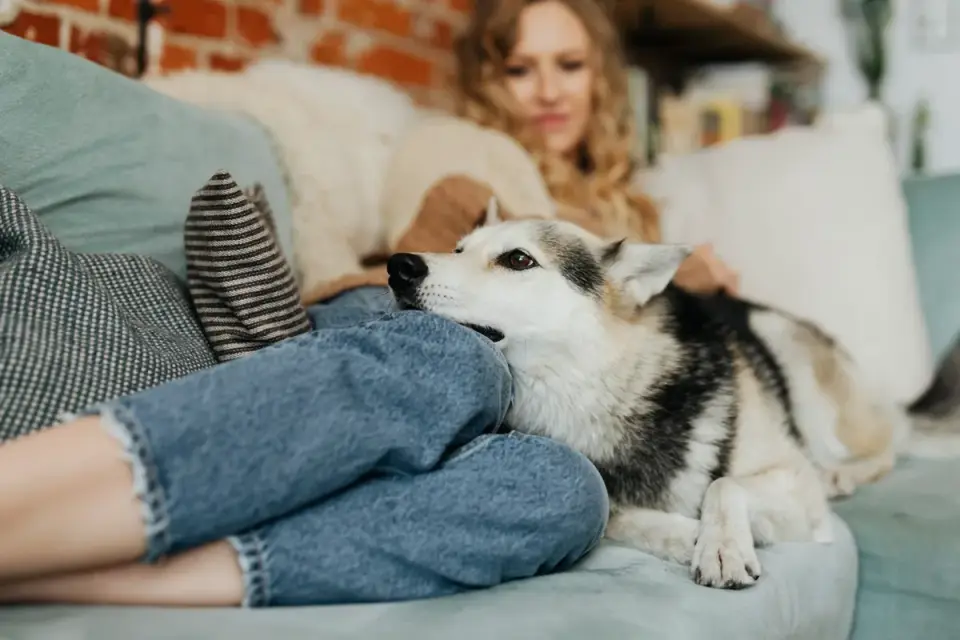
A dog that growls when you go to pet him can feel like a small betrayal, especially if he used to melt into every scratch. It usually isn’t one. Most of the time the growl is doing exactly what it evolved to do—asking for space before things get worse. Here’s how to read it, in the order the situation actually unfolds.
First, hear the growl for what it is
A growl is information. When your dog growls as you reach for him, he isn’t staging a rebellion or ‘being dominant’—he’s telling you, in the clearest language he has, that this moment doesn’t feel safe. On the ladder of canine communication, a growl sits well above the quiet signals most of us miss: the lip lick, the head turn, the freeze, the whale eye. By the time you get a growl, those softer requests have usually already gone unanswered. So the first move is the counterintuitive one: don’t punish it. The American Veterinary Society of Animal Behavior is blunt here—using force or intimidation to shut down a warning like a growl doesn’t touch the fear underneath it; it just deletes your early-warning system and raises the odds that the next escalation is a bite with no growl in front of it. A dog who gets scolded for growling learns to skip the growl, not to stop feeling uneasy.
Start with pain, especially in an older or hard-working dog
Here’s the pattern we take most seriously: a dog who used to lean into every scratch and now growls when you touch one particular area. That change usually isn’t a new personality. It’s pain. In a widely cited review of behavior-referral caseloads, veterinary behaviorists estimated that a conservative one-third of problem-behavior cases involved some form of painful condition, and in some caseloads the figure ran as high as roughly 80% (Mills et al., 2020). Musculoskeletal pain topped the list, alongside gastrointestinal and skin conditions.
For the active dogs we write about, the usual suspect is the joint. Osteoarthritis brings stiffness and soreness, but it also builds anticipatory pain—the dog learns that pressure on a sore hip or elbow is about to hurt, so he warns you before your hand even lands (Merck Veterinary Manual; VCA Animal Hospitals). A growl when you stroke the lower back, run a hand down a hind leg, or lift him onto the couch is worth mapping. So is a growl that shows up the day after a long hike or a hard training weekend, when tissue is inflamed and the recovery window hasn’t closed. Ear infections, dental pain, a stiff neck, an anal-gland problem—any localized ache can turn a favorite petting spot into a no-go zone.
Fear, history, and the consent test
Not every growl is pain. Some dogs growl when petted because the touch itself feels threatening: a rescue carrying a rough history, a hand reaching over the head, a startled pat mid-nap, or a child looming over a resting dog. Reading whether your dog actually wants contact is a skill you can learn. Trainers and veterinary behavior groups teach a simple consent test—pet for a second or two, then stop and take your hands back. A dog who wants more will nudge your hand, lean in, or reangle for another pass. A dog who moves off, looks away, licks his lips, or just goes still is telling you he’s done, and pushing past that quiet ‘no’ is exactly where growls, and eventually snaps, come from (Preventive Vet).
What to do the moment it happens
In the moment, keep it boring and safe. Stop petting and slow down—you don’t need to yank your hand away in a panic, but the reaching stops. Give your dog room to move; don’t corner him or lean over him. Skip the correction, the sharp ‘no,’ and the hard eye contact, all of which pile pressure onto a dog who’s already over threshold. Then take thirty seconds to note the details while they’re fresh: where your hand was, what position he was in, whether he’d just been sleeping or exercising. Those specifics are the single most useful thing you can hand a veterinarian.
What to do this week
One explainable growl—you startled a sleeping dog, once—might just be a lesson in better manners on your end. A growl that repeats, that’s new for your dog, or that lines up with a specific body part earns a veterinary exam before any training plan. Because pain hides so well and reads so convincingly as ‘grumpiness,’ the exam comes first; a dog can’t relax his way through counter-conditioning if the real problem is a joint that hurts every time you touch it. If the workup is clean and the growling turns out to be fear- or handling-based, a veterinary behaviorist or a qualified reward-based trainer can build a desensitization plan. We’ll raise the training-load and exercise questions too—but those calls belong to your vet or a canine sports-medicine specialist, not to a checklist on a page.
The short version
A growl during petting is a warning, not a betrayal. Read it as your dog asking for space, then rule out pain first—it’s the most common cause and the most fixable, and it’s easy to mistake for a bad mood. Don’t punish the growl, use a consent test to check whether your dog actually wants the contact, and bring specifics to a vet if it keeps happening. Keep the early-warning system intact, and you keep the trust that makes the next scratch behind the ears a welcome one.
Frequently asked questions
Should I stop petting my dog the moment he growls?
Yes. Stop reaching, give him room to move, and don't punish or correct the growl. Punishing it teaches a dog to skip the warning next time, not to feel any safer—which is how growl-free bites happen.
Why does my dog growl when I pet him but then lean back in for more?
Mixed signals usually mean your dog wants contact but a specific spot or kind of touch bothers him—a sore hip, an ear, or a hand reaching over his head. Try a consent test: pet for a second, pause, and let him show you whether he wants another pass.
Does growling when petted mean my dog is aggressive?
Not on its own. A growl is communication, not a character flaw. Most cases trace back to pain or fear, and both are far more treatable than an 'aggressive dog' label suggests.
When should I see a vet about it?
Book an exam if the growling is new for your dog, repeats, or maps to a particular body part. Because pain mimics grumpiness so well, a physical workup should come before any training plan.
Sources
- Pain and Problem Behavior in Cats and Dogs — Mills et al., Animals (MDPI) 2020, 10(2):318, doi:10.3390/ani10020318
- Position Statement on Humane Dog Training — American Veterinary Society of Animal Behavior (AVSAB)
- Osteoarthritis in Dogs and Cats — Merck Veterinary Manual
- Arthritis in Dogs — VCA Animal Hospitals
- Does Your Dog Actually Want to Be Petted? Try the Consent Test — Preventive Vet