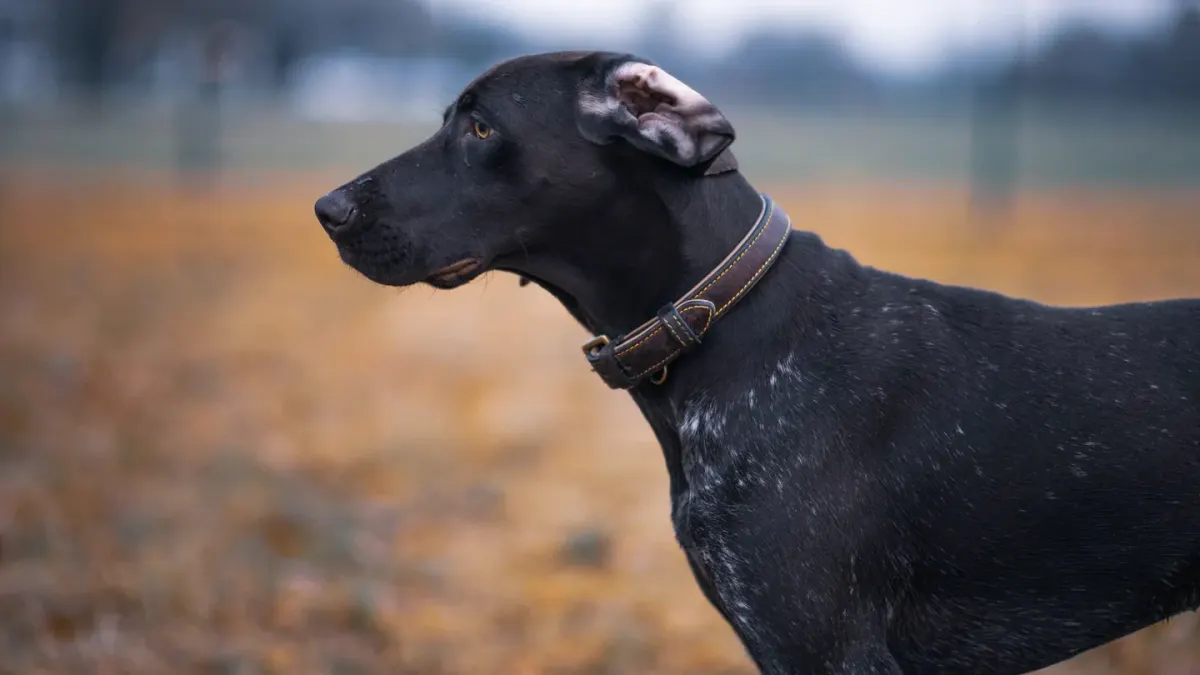
You hear him before you see him — tags clanking against a buckle as a Border Collie mix scrambles up a granite wash, then launches straight through the creek below.
By the time his owner catches up, the front of that shiny stamped tag is already scuffed pale, the number half-gone, and the split ring is stretched just enough to worry you. If that dog had slipped his collar a mile back, that tag would not have brought him home.
My verdict for active teams: pick a flat, silent tag that rides tight to the collar, carries three lines you can read at arm’s length, and pairs with a microchip as backup. Noise and shine do not find lost dogs — legibility does.
What the trail does to a tag first
Load matters here, not just looks. Every stride swings a hanging tag against rock, buckles, brush, and the D-ring itself. Add grit and repeated swims, and thin stamping wears smooth while ink-printed letters fade.
That is why depth of engraving beats decoration. Laser-etched or deeply engraved lettering on stainless steel or anodized aluminum may help support long-term readability because the mark sits below the wear surface. Thin surface printing sits on top of it, so it takes the abrasion first.
Vets often see the other half of the problem in the exam room: the ring fails before the letters do. A standard split ring opens under brush snags, and a dangling tag is a snag risk of its own.
Flat slide-on plates and riveted collar nameplates solve both issues. They do not jingle, they do not catch, and they keep the text facing out where someone can read it without grabbing your dog’s neck.
How much information earns its space
Three lines is the sweet spot for most active dogs:
- Dog’s name and one recall cue — “MILO — NEEDS MEDS”
- Your cell number, with area code
- Second number or “MICROCHIPPED” plus city
Skip the address. You need a finder to call you now, not mail you later. If your dog has a health condition that changes handling, that phrase earns line one.
Erin in Corona learned this with Isabel, her 9-year-old spayed Cane Corso. Isabel is strong, social, and loud on leash, but she went quiet and stiff after 2 miles on a hot fire road. Erin’s hanging tag had polished blank on one side, so a trail runner who stopped to help could not read the second number. After that day she switched to a slide-on plate with two phone numbers in large type, and she keeps the collar snug enough that she can still fit two fingers under it on a 110-pound neck.

That sizing detail matters more than people think. Guidance on collars and tags from the American Kennel Club emphasizes a legible tag with current contact information as the fastest way home, and a collar that stays on without choking is part of that system.
You’ll want to check fit the way you check other gear. A harness guide like Front-Clip vs Back-Clip Dog Harness: What the Biomechanics Actually Say is useful context for where straps rub, and the same logic applies to where a tag sits — if it slides under a strap or pack belly band, a finder won’t see it. Many handlers run the ID on the collar and keep the harness clean for work, which also helps if you rotate setups the way Should Your Dog Carry Its Own Backpack? describes for load days versus light days.
Why a chip still belongs in the plan
A tag is for the stranger on the trail. A microchip is for the shelter on Monday.
The tag can fall off. The chip cannot, but it only works if the registration holds your current number and someone scans for it. The American Veterinary Medical Association notes that microchips provide permanent identification, paired with keeping registration details up to date, which is exactly where tags and chips complement each other.
Keep both. You’ve covered the first ten minutes and the next ten days.
For nutrition and recovery on those longer efforts, fueling still counts as safety gear — see Can Dogs Eat Blueberries? What They Actually Add to an Active Dog’s Bowl for what a small whole-food addition can realistically do.
When to retire it
Don’t wait until it’s blank.
Rinse mud and salt water off the plate with your collar wash, then read it at arm’s length in daylight once a month. If you have to tilt it to catch the light, replace it.
It’s a $15 decision that protects a whole season.
Frequently asked questions
Should an active dog wear a hanging tag or a flat collar plate?
For brush, water, and high mileage, a flat slide-on or riveted plate usually stays more readable and quieter than a hanging tag, with less snag risk.
What should dog id tags say?
Dog’s name plus one handling note, your cell with area code, and a second number or city plus “microchipped” — large enough to read at arm’s length.
Does a microchip replace an ID tag?
No. A tag helps a finder call you immediately; a chip provides permanent backup if the collar is lost, as long as registration is current.
Sources
- Microchipping of Dogs and Cats — American Veterinary Medical Association