On this page
Jorge stands at the edge of a soccer field in Syracuse with Capo, his 3-year-old, 72-pound American Staffordshire Terrier, leaning hard into the end of the leash. A friend suggests a remote collar to “take the edge off.” It feels like a shortcut for a powerful dog that can pull a person off balance in two strides.
My call is direct: build reliable recall, loose-leash skill, and impulse control on flat equipment first, and treat any remote collar as an advanced tool that only works in trained hands. For most large-dog owners, foundation work does more for diet, mobility, and recovery than stimulation ever will, because a dog that can settle and move well stays sounder under load.
Why power changes the equation
A 70-pound dog at a trot produces far more force through the neck, shoulders, and handler’s shoulder than a 15-pound dog. That load magnifies timing errors. A late or poorly conditioned cue can startle, suppress behavior without teaching an alternative, or damage trust right when you need cooperation.
Vets often see the same pattern in practice: pulling, jumping, and selective recall paired with inconsistent reinforcement history. In those dogs, adding intensity rarely fixes the gap. The American Veterinary Society of Animal Behavior advises that humane foundation methods should come first, with attention to reward timing, criteria, and stress signals.
What a supplement or tool can realistically do here is narrow. Food therapy, joint-support nutrition, and conditioning may help support tissue tolerance and recovery windows, but they do not replace repetitions.
What has to be solid before you consider stimulation
If you want a large dog to be reliable off leash, prove it on leash first. That means a recall that holds around squirrels and soccer practice, a down-stay while you place the food bowl, and loose-leash walking past other dogs without vocal correction.
Use high-value food in short sessions, then layer distance, duration, and distraction. The Merck Veterinary Manual describes this same learning sequence: reward the behavior you want, manage the environment so the wrong choice is less likely, and raise criteria gradually.
Mechanics matter more than muscle.
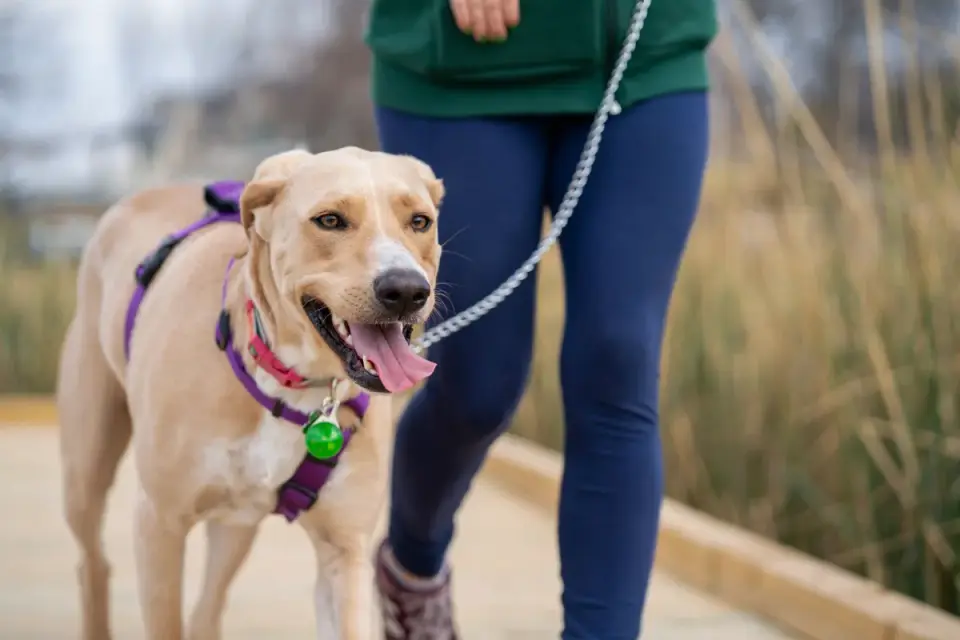
For strong pullers, fit often beats force. Compare front-clip vs back-clip harness biomechanics and revisit what actually changes with a large dog vs a small dog before you change tools.
The cautious case against rushing to shock
Remote collars combine tone, vibration, and electrical stimulation, and large-dog models often advertise longer range and higher output. Range does not equal skill. Poor contact through thick coat, too-high starting level, and continuous stimulation during panic are common failure points.
There is a reason sports-medicine teams talk about load management. Every aversive rep is load on the nervous system. A dog that trains in fear moves stiffly, breathes faster, recovers slower, and learns less per rep.
You’ll get further by auditing sleep, daily mileage, and reinforcement rate first.
If a pro uses one, what careful use looks like
Some working-dog trainers use low-level conditioned cues after months of positive conditioning, with the dog taught how to turn the sensation off by offering the correct behavior. That protocol requires a fitting check, a working-level test at the lowest perceptible setting, and a coach watching timing in real time.
That is not a weekend project.
Do not use a remote collar for fear, aggression, separation distress, or unsupervised containment. Do not use it on a dog under six months, on injured or post-surgical tissue, or to punish a recall that already failed. If you see yelping, shutdown, avoidance of the yard, or skin irritation under the contact points, stop and get in-person help from a credentialed trainer and your veterinarian.
A practical next step for Capo — and dogs like him
Jorge skipped the purchase for eight weeks and logged four five-minute recall sessions per week on a long line, plus two structured walks per day with a fitted front-clip harness. Capo’s recall around the field improved enough that Jorge could call him off a chase at 30 feet, and his shoulders stopped slamming the harness at every squirrel.
That outcome is typical when volume and criteria are managed. Train the base, protect the joints, fuel recovery, and only then — with professional eyes on you — decide whether any remote cue still has a job to do.
Frequently asked questions
Are shock collars safe for large dogs?
Fit, timing, and training history matter more than size. Because powerful dogs amplify errors, most owners get safer, more reliable results from reward-based recall and leash skills first, with professional guidance if a remote collar is ever considered.
Will a shock collar stop pulling in a big dog?
It may interrupt pulling in the moment, but it does not teach loose-leash walking. Harness fit, reinforcement for position, and gradual distraction training build the behavior that lasts under load.
What should I try before a remote collar?
Short daily recall reps on a long line, a well-fitted front-clip harness, management to prevent rehearsal of pulling, and enough sleep and recovery between hard exercise days.
Sources
- AVSAB Position Statement on Humane Dog Training — American Veterinary Society of Animal Behavior