
On this page
Late September on a crowded farmers market loop, an owner flagged me down beside her panting 9-pound, 7-year-old Italian Greyhound. The little dog had trotted bravely for forty minutes, then sat down hard, hind legs trembling, nails clicking on pavement. She had a soft-sided backpack carrier folded in her tote and asked the question I hear weekly: is it kinder to carry him the rest of the way, or does that coddle him? That tradeoff — tissue tolerance on one side, conditioning and confidence on the other — is what a dog backpack carrier for a small dog is really for, and getting it right starts with fit and ventilation, not fabric color.
My quick screen before you buy:
- Dog weight and length set the size, not the label that says small — measure chest girth, back length, and standing height
- Leg position matters more than padding: supported sternal recumbency beats dangling legs for joint comfort
- Airflow and head clearance decide heat tolerance — mesh panels, top opening, no chin compression
- Your torso carries the load — wide shoulder straps, chest strap, and lumbar support beat a tote strap
- Entry style predicts compliance — top-loading for wrigglers, side zip for seniors with stiff hips
- Cleanability and structure — washable liner, rigid base that does not sag under 12-15 pounds
- Plan the exit — a carrier is a recovery window, not all-day housing
That is the filter. Padding alone never saves a bad shape.
When does carrying support recovery instead of replacing fitness?
For Loadline readers I frame this as load management. Small breeds log high steps per mile, lose heat fast when stopped, and often have less cartilage margin in patellas and elbows. A carrier lets you extend enrichment — distance, novelty, social exposure — while capping repetitive impact.
I weigh what a supplement can realistically do for diet, mobility, and recovery in the same way I weigh a carrier: as a support for whole-patient health, not a fix. A carrier may help support joint comfort on long outings by shortening continuous walking bouts, and food therapy plus consistent fueling and rest still do more for recovery than any gear change. Quality systems matter here too, which is why I point owners toward the quality-mark thinking taught by the National Animal Supplement Council when they evaluate any support product, and toward nutrient basics from the Office of Dietary Supplements when diet questions come up.
Short version in practice: walk the first loop, ride the second.
What fit actually looks like on a 6- to 18-pound body?
Forget S/M/L. Put the dog on a table and measure: chest just behind elbows, length from withers to tail base, and height from floor to top of head sitting. The carrier base should exceed back length by 2 inches so the dog can tuck without curling its neck.
Inside, look for a flat, semi-rigid floor. Hammock bottoms force the spine into flexion and load the hips unevenly. The head opening should clear the trachea by two fingers; if the rim presses the throat when the dog turns, size up or choose another cut.
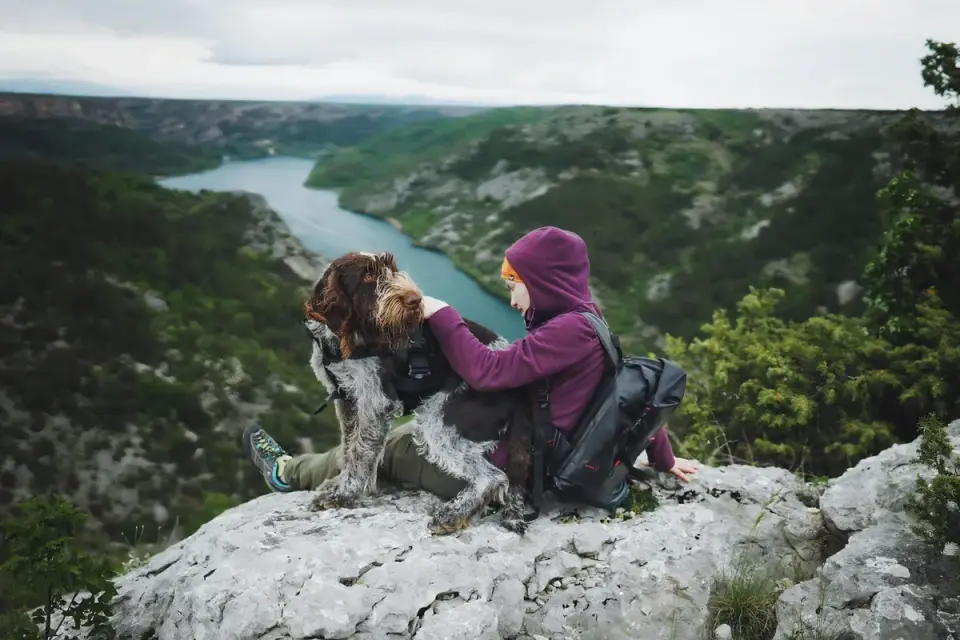
I learned this the hard way with a borrowed carrier on a beach boardwalk three summers ago. My test companion was a 12-pound, 5-year-old rescue terrier mix with a luxating patella history, game for a mile but done by mile two. The borrowed pack had thin cord straps and a sack bottom with no frame. By day 2 of trying it on short walks, she braced her forelegs on the rim, sagged sideways, and refused entry — a clear failed approach. The tradeoff was obvious: I had saved money but added postural load to both of us. We retired it and went back to measuring girth and base stiffness before brand.
Pair fit work with broader conditioning ideas in Exercise Ideas for Toy and Small Breeds: A Load-Smart Guide so the carrier supplements walking rather than replacing it.
How do I keep heat, breathing, and nerves in the green?
Small dogs overheat when airflow is blocked, not only when it is hot. Choose three-sided mesh, a light-colored shell, and a top that opens fully for panting room. The nose and mouth must stay unobstructed, with space to turn the head without folding an ear.
Acclimation is nutritional evidence applied to behavior: short, rewarded reps build tolerance. Start with treats in the open carrier on the floor, then 2-minute carries indoors, then a quiet block. Watch respiratory rate, lip licking, and willingness to step in. Food-motivated training grounded in normal fueling beats flooding every time.
Load is load, even when you are the one carrying it.
If you travel often, read Traveling With a Small Dog vs a Large Dog: What Actually Changes for crate, temperature, and transit planning that pairs with carrier use.
What is the edge case that changes the plan?
Not every small dog should ride chest-forward facing out. By week three of a fall hiking block, an owner reported her 11-pound, 10-year-old senior poodle mix panted less in the pack but came home stiff the next morning after two 90-minute rides. On video the cause was clear: she perched with forelegs over the rim, cervical spine extended, hips flexed for the whole ride. For seniors with neck arthritis or collapsing trachea tendencies, that posture is a poor recovery window. We switched to a fully enclosed side-carry with a flat resting pad, shortened rides to 30 minutes with walk breaks, and her morning latency to stand dropped from minutes to seconds. The carrier still worked — the position had to change.
That is also why I separate human-carry packs from dog-worn packs. If you are wondering whether the dog should haul its own gear, see Should Your Dog Carry Its Own Backpack? before adding any wearable weight.
The strongest counterargument I hear is that carriers decondition small dogs and create anxious passengers. There is truth in it when the pack becomes default transport. My answer stays evidence-bounded: cap continuous carried time, preserve daily walking volume your veterinarian approves, and use the pack to protect tissue tolerance on terrain, crowds, or heat that would otherwise end the outing. Support recovery, keep feeding the base.
Frequently asked questions
What weight limit should I look for in a dog backpack carrier for a small dog?
Match measured chest girth and back length first, then confirm the rated limit exceeds your dog's weight by 3-5 pounds. Most small-dog packs rate to 15-18 pounds, but base stiffness matters more than the number on the tag.
Are legs-out or fully enclosed carriers better for joints?
For most seniors and dogs with patella issues, a supported enclosed base with sternal recumbency keeps the spine neutral. Legs-out designs are fine for brief, well-tolerated rides if the chest rim does not compress the trachea and legs are not dangling under load.
How long can my small dog stay in a backpack carrier?
Keep initial rides to 20-30 minutes with walk and water breaks, then extend only if breathing stays easy and the dog exits willingly and moves normally afterward. Any prolonged panting, bracing, or next-day stiffness means shorten the next bout.
Sources
- About NASC — National Animal Supplement Council
- Dietary Supplements Information — Office of Dietary Supplements